
We are a professionally registered construction company delivering reliable residential, commercial, and industrial projects with quality, transparency, and expert engineering since 2019.
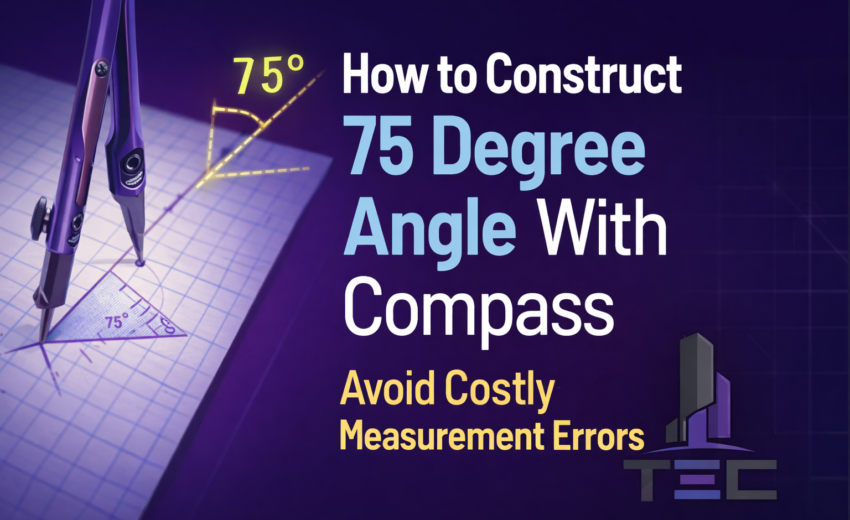
How to Construct 75 Degree Angle With Compass is a fundamental skill in construction planning, where even a small measurement mistake can lead to serious structural and financial loss. In Pakistan’s growing construction industry, accurate angles are vital for layout marking, design execution, and renovation work. At Town Engineering & Construction Company (TECCO), precision in measurements is the foundation of quality construction, whether the project involves new construction, home renovations, or design planning.
Accurate angle construction helps avoid material waste, rework, and alignment issues that often appear later during execution. That is why understanding manual angle construction methods remains important even in modern construction environments.
How to Construct 75 Degree Angle With Compass
How to Construct 75 Degree Angle With Compass involves using basic geometric principles that are still highly relevant in real construction layouts. This method is especially useful when digital tools or machines are not available on-site and manual accuracy is required.
Construction professionals often prefer compass-based geometry during early planning stages, site marking, and design drawings because it ensures greater precision and reduces reliance on electronic tools.
Practical Construction Uses of a 75 Degree Angle
A 75-degree angle is commonly used in:
- Site Layout and Boundary Alignment: Ensures accurate plot demarcation and proper orientation of structures.
- Staircase Construction: Custom angles optimize space efficiency and ensure safe stair design.
- Ramp Construction: Maintains smooth access and structural balance in residential and commercial buildings.
- Architectural Design Features: Supports slanted walls, façades, and elevation elements for aesthetic appeal.
- Interior Space Planning: Angled partitions improve both aesthetics and functional layout of interiors.
- Home Renovation Projects: Helps modify existing structural lines without disturbing load balance.
- Structural Detailing in Custom Construction: Used where standard right angles are not suitable.
- Design Adjustments in Older Buildings: Precise angles help integrate modern construction with existing structures, especially in Pakistan.
Knowing how to construct 75 degree angle allows construction teams to maintain symmetry, alignment, and visual balance in design. In renovation projects—especially older buildings in Pakistan—such angles help adapt new layouts to existing structures without compromising stability, safety, or finishing quality.
Tools Required for Accurate Angle Construction on Site
To properly construct 75 degree angle using compass, the following tools are essential and are used for precise measurements in construction projects:
- Compass (Well-Calibrated): Used to draw precise arcs and measure angles accurately.
- Measuring Scale or Tape: Used to mark accurate distances and baselines for angle construction.
- Chalk or Site Marker: Allows temporary markings on concrete, wood, or soil.
- Flat Surface or Drawing Board: Provides a stable surface for geometric construction before applying measurements on the actual site.
- Protractor (Optional): Can be used for cross-checking, especially in design planning or when high precision is required.
While a 75 degree angle with protractor can also be measured, construction sites often require methods where a protractor is unavailable. That is why professionals prefer learning how to construct 75 degree angle without protractor using a compass.
Step-by-Step Construction Method to Create a 75 Degree Angle
Follow these steps to construct 75 degree angle with compass accurately:
1. Draw a Baseline
Start by drawing a straight baseline on your working surface using a scale or measuring tape. This baseline acts as the reference for all subsequent measurements. A precise baseline is critical because any error here can affect the final 75 degree angle.
2. Set Your Compass
Adjust the compass to a suitable radius depending on your project size. A well-calibrated compass allows you to create smooth arcs and accurate intersection points, which form the core of the angle of 75 with compass.
3. Construct a 60-Degree Reference Angle
Using geometric principles, construct a 60-degree angle from the baseline. This reference helps accurately derive the 75 degree angle. Professionals use this step to avoid costly layout mistakes.
4. Construct a 90-Degree Reference Angle
Next, create a perpendicular 90-degree angle from the same baseline. This ensures that the bisecting process is precise, providing a reliable structure for the construct 75 degree angle using compass method.
5. Bisect the Angle to Create 75 Degrees
Carefully bisect the angle between the 60-degree and 90-degree references. This intersection creates the exact 75-degree angle needed for your layout. Verification at this stage prevents measurement errors that could compromise the project.
6. Verify and Transfer to Site
Once the 75-degree angle is constructed, double-check it using measuring tools or an optional protractor. After verification, transfer the angle accurately to your construction site. This step ensures that the layout, construction of the 75 ° angle, and structural alignment are precise.
Read More About: Pakistan Interior Design: Unlock the Secrets to Stunning Home Makeovers
Top Construction Companies in Pakistan
How Home Construction Companies in Lahore Can Help You Build Your Dream Home Expertly
Common Measurement Mistakes That Lead to Costly Construction Errors
Even small measurement errors can lead to major construction problems and increased project costs. Learning how to construct 75 degree angle with compass properly helps avoid rework and ensures structural accuracy. Below are the most common mistakes to watch out for during construction layout:
1. Loose Compass Settings
A loose or improperly adjusted compass can create uneven arcs and inaccurate intersection points. This often results in angles deviating from the intended 75 degree angle with compass, causing misalignment in layouts and potential rework on-site.
2. Incorrect Baseline Alignment
The baseline serves as the foundation for all measurements. Any deviation or misalignment here will affect the accuracy of the angle of 75 with compass. Correct baseline marking is critical for both small renovations and large construction projects.
3. Skipping Angle Verification
Failing to verify the angle after construction is a common error. Without checking, the construction of 75 angle may be slightly off, leading to cumulative errors across the site. Always cross-check your angles before applying them.
4. Rushing the Marking Process
Speeding through the marking process often causes errors in arcs and intersections. Taking sufficient time ensures a precise construct 75 degree angle using compass, which ultimately saves material and prevents costly mistakes.
5. Ignoring Tool Calibration
Using uncalibrated or worn-out compasses and scales can create inaccuracies. Proper calibration guarantees that your measurements are consistent, making it easier to construct 75 degree angle without protractor reliably.
6. Misreading Reference Angles
Confusing 60°, 75°, or 90° reference points can result in incorrect angles. Correctly identifying and bisecting reference angles is crucial to maintaining layout integrity and achieving accurate on-site results.
Such errors may look minor initially but often result in expensive corrections later. Understanding how to construct 75 degree angle with compass properly helps avoid these risks.
How Accurate Angle Measurement Improves Design & Renovation Results
When construction teams correctly construct 75 degree angle using compass, the results are visible in design symmetry, structural balance, and finishing quality. In home renovation projects, precise angles help align new additions with existing structures. Design accuracy improves space utilization, while proper angle control increases long-term durability. This is why professional builders rely on tested geometric methods rather than guesswork.
Professional Construction Practices That Prevent Layout Errors
Professional construction companies implement strict verification and quality control measures before starting any layout work. These include careful supervision, precise measurements, and coordination between design and execution teams. By maintaining high standards, they ensure that all structural elements are correctly aligned. Such disciplined practices minimize errors and improve overall project efficiency, making the workflow smoother and more reliable.
Adopting these methods also helps reduce rework, control costs, and keep project timelines on track—critical aspects for construction success in Pakistan. Ensuring accuracy at every stage ensures strong, stable structures. Learning how to construct 75 degree angle with compass is an essential part of these professional practices.
How Town Engineering & Construction Company (TECCO) Ensures Precision
At Town Engineering & Construction Company (TECCO), every project emphasizes accurate measurement and layout verification. Their services cover construction, design, home renovation, and solar solutions, all executed with precision. TECCO’s teams follow proven geometric methods to plan and mark layouts before any construction begins. This systematic approach ensures that projects are efficient, error-free, and structurally sound.
By blending traditional construction techniques with modern planning tools, TECCO consistently delivers projects that meet both aesthetic and engineering standards. Their meticulous process reduces mistakes, saves time, and guarantees quality. Learning how to construct 75 degree angle with compass is an integral part of TECCO’s precision-driven workflow.
Conclusion
Mastering How to Construct 75 Degree Angle With Compass is not just a technical skill—it is a safeguard against costly construction mistakes. From site layout to renovation planning, accurate angles ensure better outcomes and long-term reliability.
Whether you are planning a new project or upgrading an existing structure, understanding how to construct 75 degree angle with compass supports smarter decision-making and professional-quality results.
FAQ’s
How to construct angle 75 and 105?
To construct a 75-degree angle, draw a 60° reference and a 90° reference, then bisect the difference. For a 105-degree angle, extend the 75-degree angle by 30° using geometric methods. Both can be done with a compass and baseline.
What angle is 75 degrees?
A 75-degree angle is an acute angle, slightly larger than a 60° angle. It is commonly used in construction layouts, staircases, and design planning to achieve precise structural alignment.
How to construct 75 degree angle without protractor?
Using a compass, draw a 60° angle and a 90° angle from a baseline. Bisect the space between them to get 75 degrees accurately. This method avoids the need for a protractor on site.
Can 75 degree angles be used in home renovation?
Yes, 75-degree angles help align new partitions, ramps, or extensions with existing structures. They are crucial in maintaining symmetry and structural balance during home renovation projects.
How do I check if a 75 degree angle is accurate?
You can verify using a measuring scale or optional protractor after construction. Proper checking ensures your angle of 75 with a compass is precise before applying it onsite.